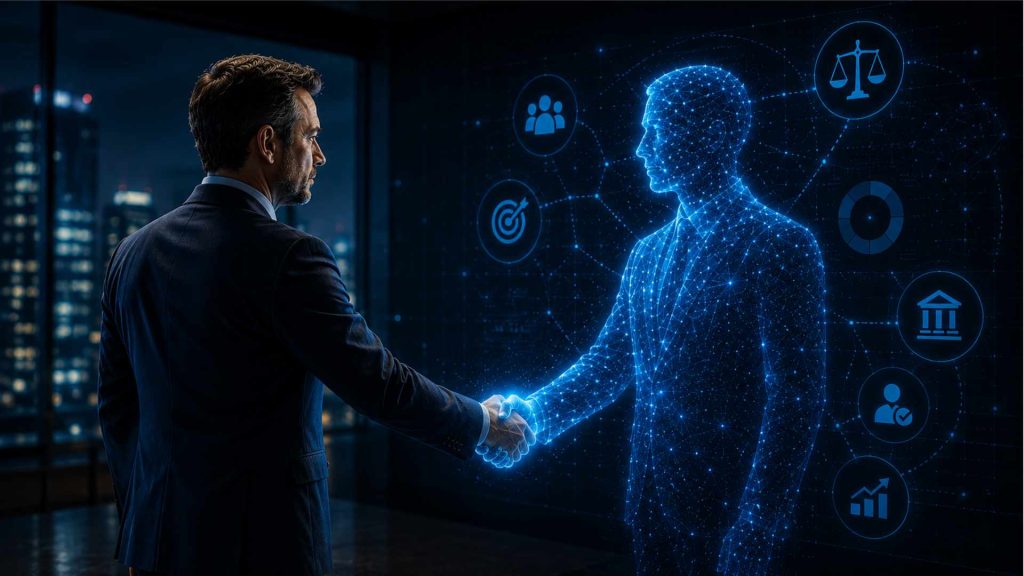

Artificial intelligence is rapidly becoming one of the defining business forces of our generation. Between generative AI, machine learning, intelligent automation, and agentic systems, organizations are being told — sometimes hourly — that they must “do something with AI” or risk falling behind.
Yet beneath the noise, a more important question is emerging:
What if the greatest value of AI is not replacing humans, but augmenting them?
This distinction matters. Much of the current conversation focuses on AI agents operating independently, automating entire workflows, or eliminating human involvement altogether. While automation has an important role to play, the greatest long-term business value may come from a different model entirely: humans enhanced by AI, not humans displaced by it.
The organizations that thrive will likely be the ones that combine machine speed with human judgment, computational power with empathy, and automation with wisdom.
That is where the real opportunity begins.
The AI-Augmented Human May Be the Most Powerful Operating Model Ever Created
AI is already transforming knowledge work at extraordinary speed. It can summarize massive amounts of information, identify patterns, accelerate analysis, generate draft content, support decision-making, and dramatically reduce repetitive administrative effort.
In many ways, AI acts like a cognitive amplifier.
But amplification is not replacement.
The most effective AI deployments today still rely heavily on humans to provide context, define intent, validate outputs, apply judgment, and communicate decisions in ways that other humans can trust and act upon.
AI may generate the first 80% faster than ever before.
Humans still provide the final 20% that creates trust, accountability, nuance, persuasion, and business value.
That final layer matters more than many realize.
The best consultants, leaders, lawyers, engineers, operators, clinicians, educators, and strategists do more than process information. They synthesize ambiguity, interpret emotion, weigh intangible factors, navigate politics, manage risk, build relationships, and exercise judgment under imperfect conditions.
These are not small details. They are often the difference between success and failure.
AI is becoming an extraordinary accelerator of knowledge work. Humans remain the integrators of meaning.
Fear Creates Hesitation. Hesitation Creates Stagnation.
Every major technological shift in history has generated anxiety.
Industrial machinery, electricity, computers, automation, and the internet were all initially viewed by some as existential threats to jobs, industries, and social stability. In many cases, those concerns were understandable. Technological transitions do create disruption.
But history also shows something else:
Humans adapt.
Entire industries emerge that previously did not exist. New forms of work appear. Productivity expands. Capability expands. Living standards improve over time. Organizations reorganize around new possibilities.
AI is likely to follow a similar pattern.
That does not mean blind optimism or reckless adoption. Responsible governance, privacy, security, oversight, and ethical controls matter enormously. But organizations that approach AI exclusively through fear may unintentionally create another risk entirely: paralysis.
Threat leads to fear. Fear leads to hesitation. Hesitation leads to stagnation.
Meanwhile, competitors continue learning.
The organizations gaining the greatest advantage today are not necessarily the ones moving the fastest. They are the ones learning responsibly, governing intelligently, and adapting confidently.
Humans Are Still in Control of the Tools
One of the more overlooked realities in the AI conversation is this:
Humans created these systems.
Humans train them.
Humans govern them.
Humans fund them.
And humans ultimately decide how they are deployed.
AI development is occurring largely within private enterprises operating inside economic, legal, regulatory, and shareholder systems that have existed for generations. Markets historically reward stability, trust, scalability, and sustainable growth. Over time, organizations that create uncontrolled risk, reputational damage, or destructive instability tend to encounter resistance from regulators, customers, insurers, investors, and society itself.
This does not eliminate risk. But it does suggest that AI evolution will likely continue moving toward stronger governance, accountability, and operational controls over time.
The future of AI is not predetermined by the technology alone.
It will be shaped by the collective decisions humans make about how these systems are designed, governed, incentivized, and integrated into society.
AI Still Has Important Limitations
Despite remarkable progress, modern AI systems remain fundamentally limited in several important ways.
AI does not possess human consciousness, emotional understanding, lived experience, moral intuition, or true comprehension of meaning. It predicts patterns based on training data. It does not “understand” reality the way humans do.
Today’s AI systems can still:
• hallucinate incorrect information confidently
• struggle with context outside their training boundaries
• reflect biases present in training data
• misinterpret nuance, sarcasm, emotion, or cultural context
• fail in unpredictable edge cases
• produce outputs that sound persuasive but are factually flawed
• lack accountability or ethical reasoning independent of human oversight
This is precisely why governance, human review, and operational controls remain essential.
AI should support decision-making — not silently replace it in high-risk environments where judgment, ethics, accountability, and contextual understanding matter deeply.
The organizations achieving sustainable value are not removing humans from the loop entirely. They are redesigning workflows where humans and AI each contribute what they do best.
AI Should Remove Human Friction — Not Human Purpose
Perhaps one of the most exciting opportunities in AI is not eliminating meaningful work, but eliminating unnecessary friction surrounding meaningful work.
One social media post captured this idea perfectly:
“I don’t want AI to write my legal briefs and blog posts so I have more time to cook and clean. I want AI to cook and clean so I have more time to write legal briefs and blog posts.”
That perspective resonates because it reframes the role of technology.
The real opportunity is not to reduce humans into passive overseers of machine output. It is to free people from repetitive, low-value administrative burden so they can spend more time thinking, creating, leading, solving problems, mentoring others, innovating, and building relationships.
In business terms, this means AI may be most powerful when it:
• removes repetitive cognitive workload
• accelerates information retrieval
• simplifies coordination
• reduces rework and administrative burden
• improves decision visibility
• supports better planning and forecasting
• strengthens operational consistency
• expands access to knowledge and expertise
The future of work may not become less human.
It may become more deeply human precisely because AI absorbs more mechanical workload.
The Organizations That Win Will Blend Technology With Humanity
The next generation of successful organizations will likely not be defined by AI adoption alone. Many companies will have access to similar tools.
The differentiator will be how intelligently organizations integrate AI into leadership, governance, workflows, culture, and decision-making.
AI without governance creates chaos.
AI without adoption creates shelfware.
AI without leadership alignment creates fragmentation.
And AI without humanity creates distrust.
But when organizations combine strong governance, ethical controls, leadership alignment, workforce readiness, and practical implementation discipline, AI becomes something far more powerful:
A force multiplier for human capability.
Used responsibly, AI may even help organizations reduce volatility and improve decision quality by identifying emerging risks, surfacing patterns humans may miss, strengthening scenario planning, and supporting earlier intervention before small problems become destructive ones.
In that sense, AI may eventually function less like an autonomous decision-maker and more like a highly sophisticated organizational early-warning system — one that helps humans make better decisions before damage occurs.
The key word remains humans.
The future does not belong to AI alone.
It belongs to people who learn how to work with it wisely.
How Blue Monarch can Help
At Blue Monarch Management, we believe the future of AI is not simply about technology deployment. It is about strengthening how organizations think, decide, operate, and adapt in increasingly complex environments.
Many organizations are currently investing in AI tools, pilots, and experimentation. The challenge is rarely the availability of technology. The harder challenge is translating AI ambition into leadership alignment, operational readiness, governance discipline, workforce adoption, and measurable business value.
That is where Blue Monarch focuses.
Our approach is grounded in the belief that AI should enhance organizational capability — not create fragmentation, unmanaged risk, or disconnected experimentation. We help organizations move from AI uncertainty to practical, governed implementation by aligning technology decisions with business realities, operating conditions, and human adoption.
Through our AI Maturity & Opportunity Diagnostic, we help leadership teams:
- identify where AI can responsibly create value
- assess organizational readiness and constraints
- evaluate governance, risk, and data conditions
- prioritize high-impact opportunities
- strengthen workforce and leadership readiness
- establish practical implementation roadmaps
- create the conditions for scalable adoption and measurable outcomes
We do not view AI as a standalone technology initiative. We view it as part of a broader management system involving governance, operations, leadership, workflows, data, people, and decision-making.
Most importantly, we believe organizations will create the greatest long-term value when AI strengthens human capability rather than attempting to replace it entirely.
The future belongs to organizations that combine technology with judgment, automation with accountability, and intelligence with humanity.
That is the future Blue Monarch is helping organizations build.