By Mark Buzan, APR-CAE
Why do organizations with intelligent people, strong missions, and capable leadership teams still struggle to execute?
After years working as an Executive Director and management consultant with associations, nonprofit organizations, and multi-stakeholder boards, I’ve noticed a recurring pattern that quietly undermines performance long before a financial crisis or leadership breakdown appears.
I call it organizational decision drift.
Decision drift happens when an organization slowly loses alignment between its strategy, governance, operations, and day-to-day decisions. It rarely happens overnight. Instead, it emerges through small compromises, delayed decisions, unclear accountability, shifting priorities, and leadership fatigue.
At first glance, things may appear stable. Meetings continue. Reports are produced. Staff stay busy. Yet underneath the surface, execution slows down, opportunities are missed, and organizational confidence begins to erode.
While this problem is common in associations and nonprofits, it is absolutely not limited to them.
I’ve seen the same issue affect private sector companies, industry associations, professional regulators, economic development organizations, and even public sector bodies.
The symptoms are remarkably similar:
- Strategic plans that never fully translate into action
- Boards revisiting the same issues repeatedly
- Leadership teams operating reactively instead of proactively
- Growing tension between governance and operations
- Staff burnout caused by unclear priorities
- Stakeholder frustration over lack of visible progress
- Departments or committees moving in competing directions
- Organizations becoming overly dependent on a few individuals
In many cases, leaders assume the problem is staffing, communication, or funding. Sometimes it is. But often, the deeper issue is that the organization has lost decision discipline and organizational alignment.
This is where external management consulting support can become highly valuable.
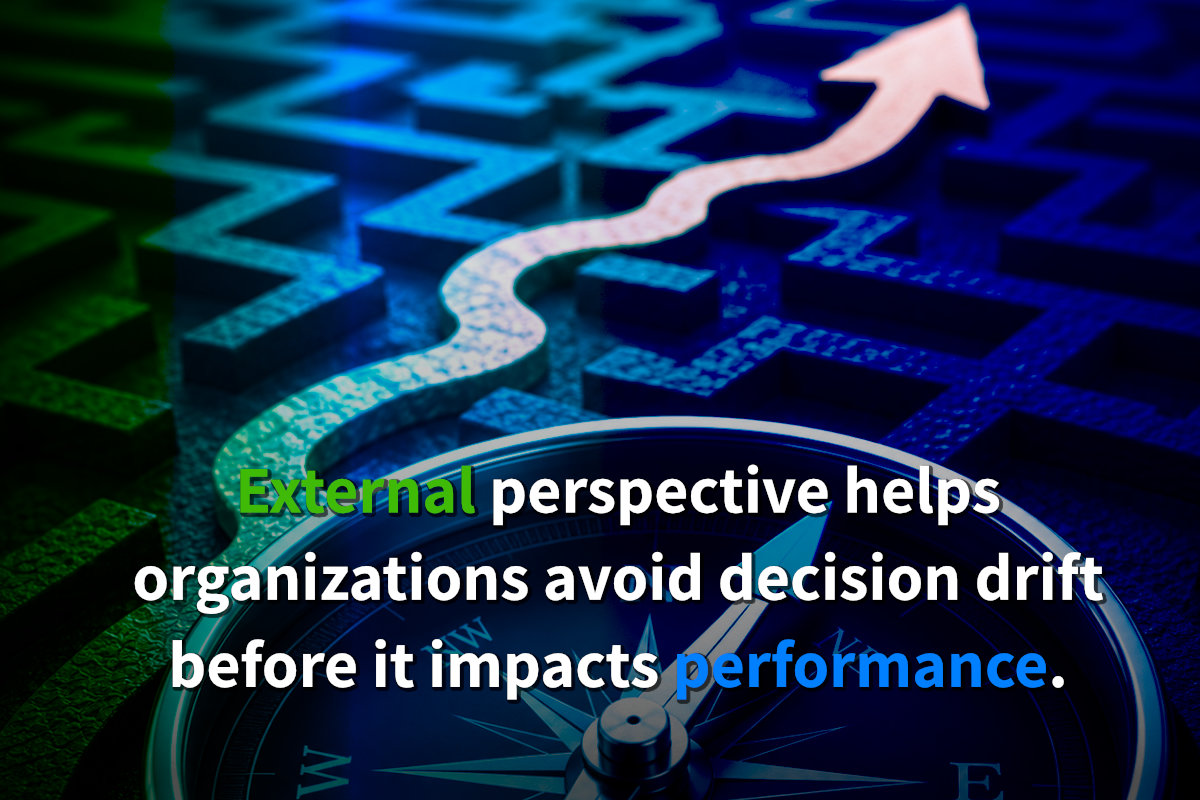
One of the advantages an outside strategic planning consultant or governance advisor brings is perspective without institutional blind spots. Internal teams are often too immersed in the daily pressures of the organization to clearly identify where drift began or why execution has stalled.
An experienced outside consultant can help leadership teams:
- Re-establish strategic clarity
Align governance with operational realities - Improve executive and board accountability
- Streamline decision-making structures
- Identify organizational bottlenecks
Clarify roles between staff, executives, and boards - Build practical implementation frameworks instead of theoretical plans
Importantly, organizational decision drift is not always caused by incompetence. In fact, it often happens in organizations filled with highly committed people. The issue is usually that growth, complexity, stakeholder pressures, and competing priorities gradually outpace the systems designed to manage them.
This is especially true in organizations experiencing rapid expansion, leadership turnover, volunteer burnout, political pressures, or evolving market conditions.
Strong governance and strategic planning are not static exercises. They require ongoing recalibration.
Organizations that recognize decision drift early are often able to reverse it before morale, revenue, stakeholder confidence, or organizational culture deteriorate further.
Those that ignore it tend to spend years trapped in cycles of operational frustration, stalled initiatives, and internal friction.
Whether in the nonprofit sector, private enterprise, professional associations, or public institutions, the organizations that perform best over time are usually not the ones with the most resources. They are the ones that maintain strategic clarity, disciplined decision-making, and alignment between leadership vision and operational execution.
And increasingly, that requires outside perspective.